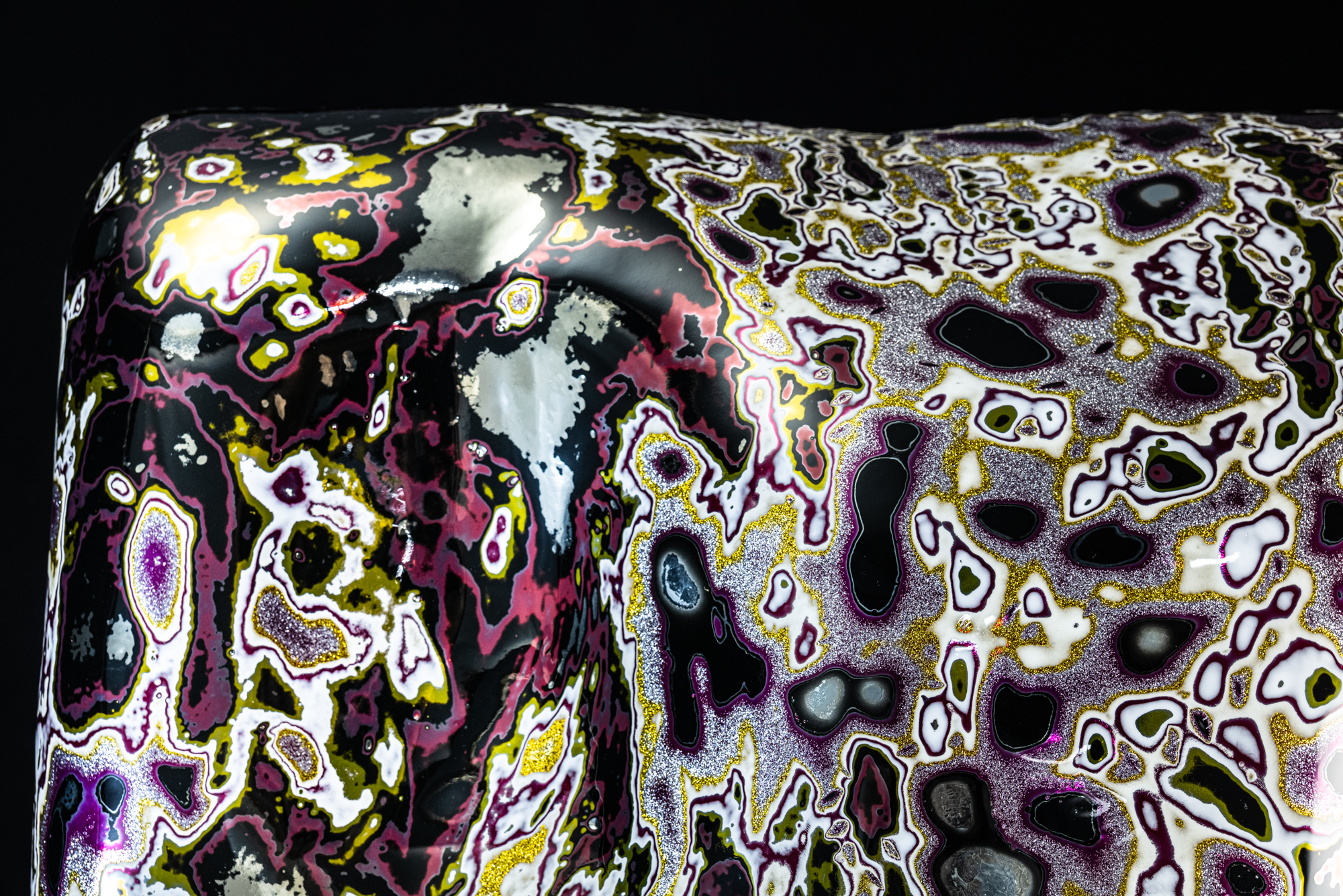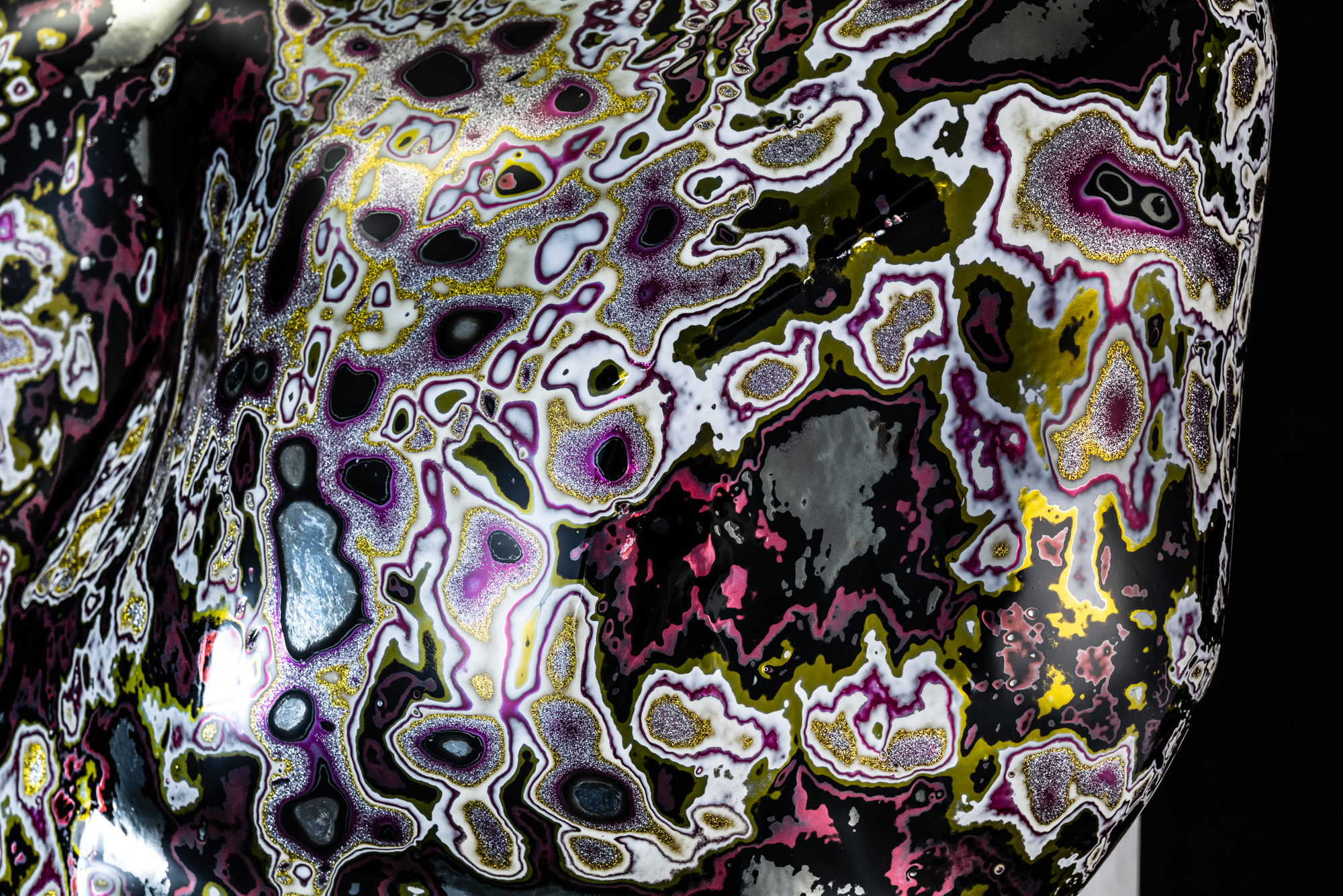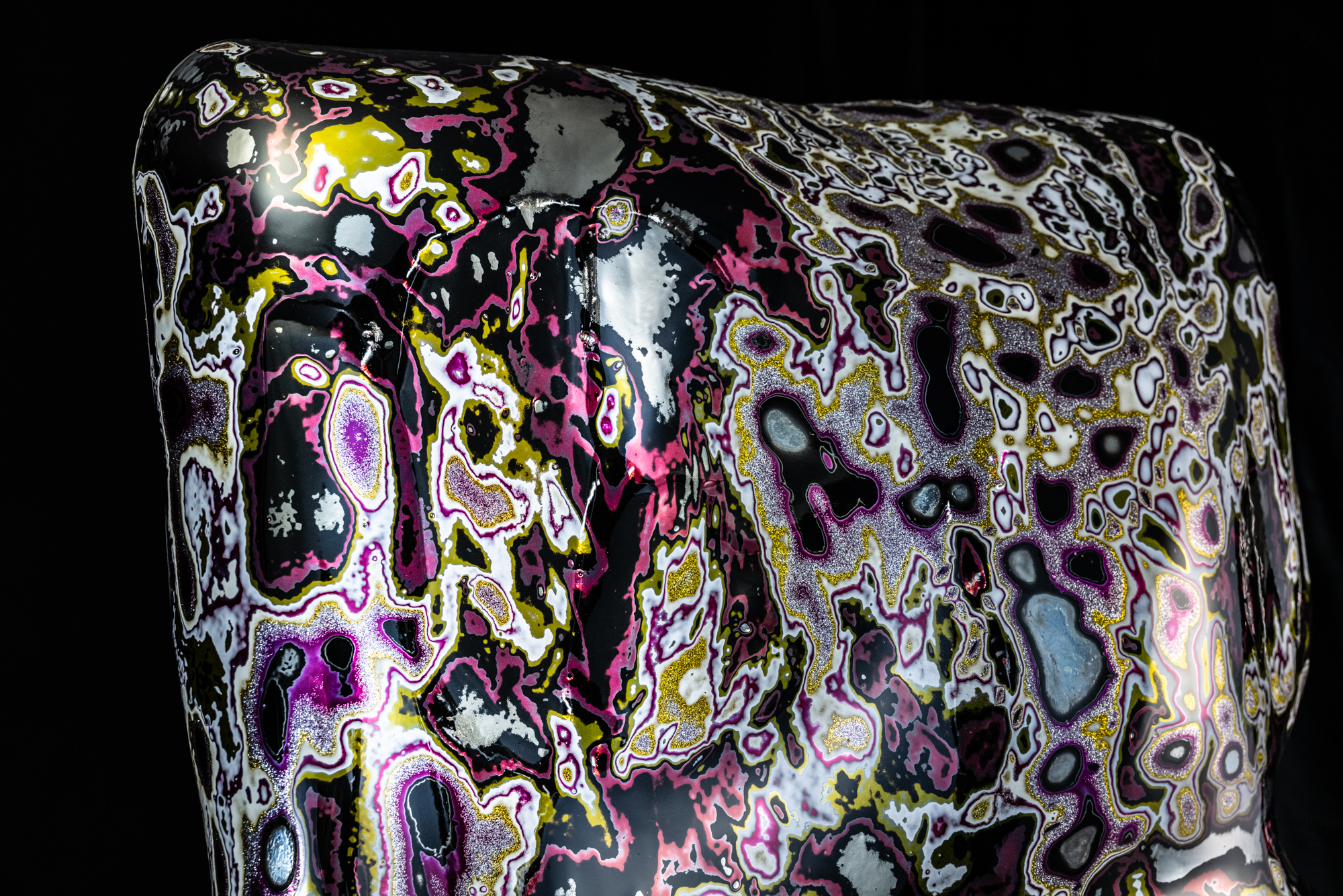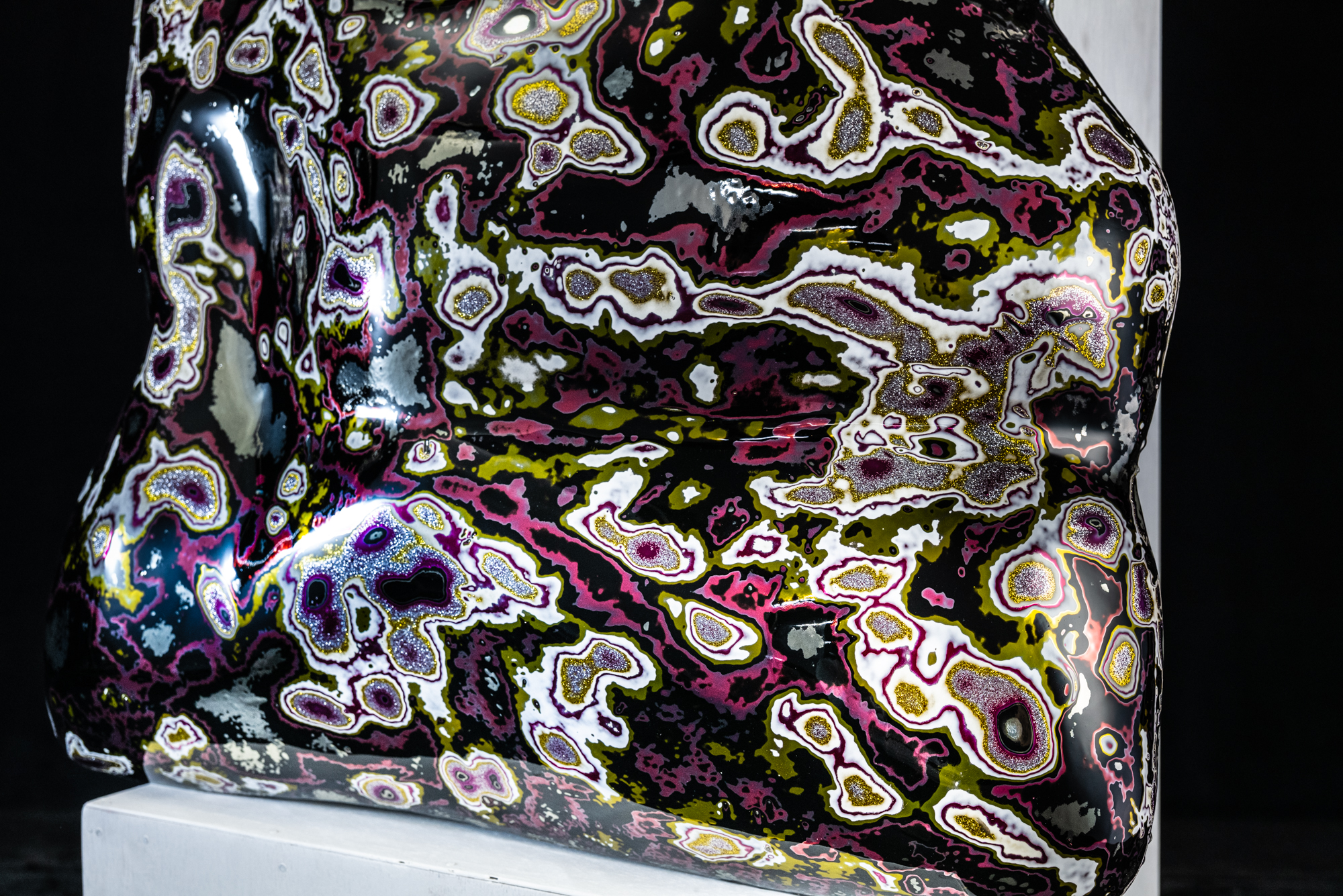
HAZE FRP 30
UNDULATION: HAZE / The Abnormal Conceals Light #01
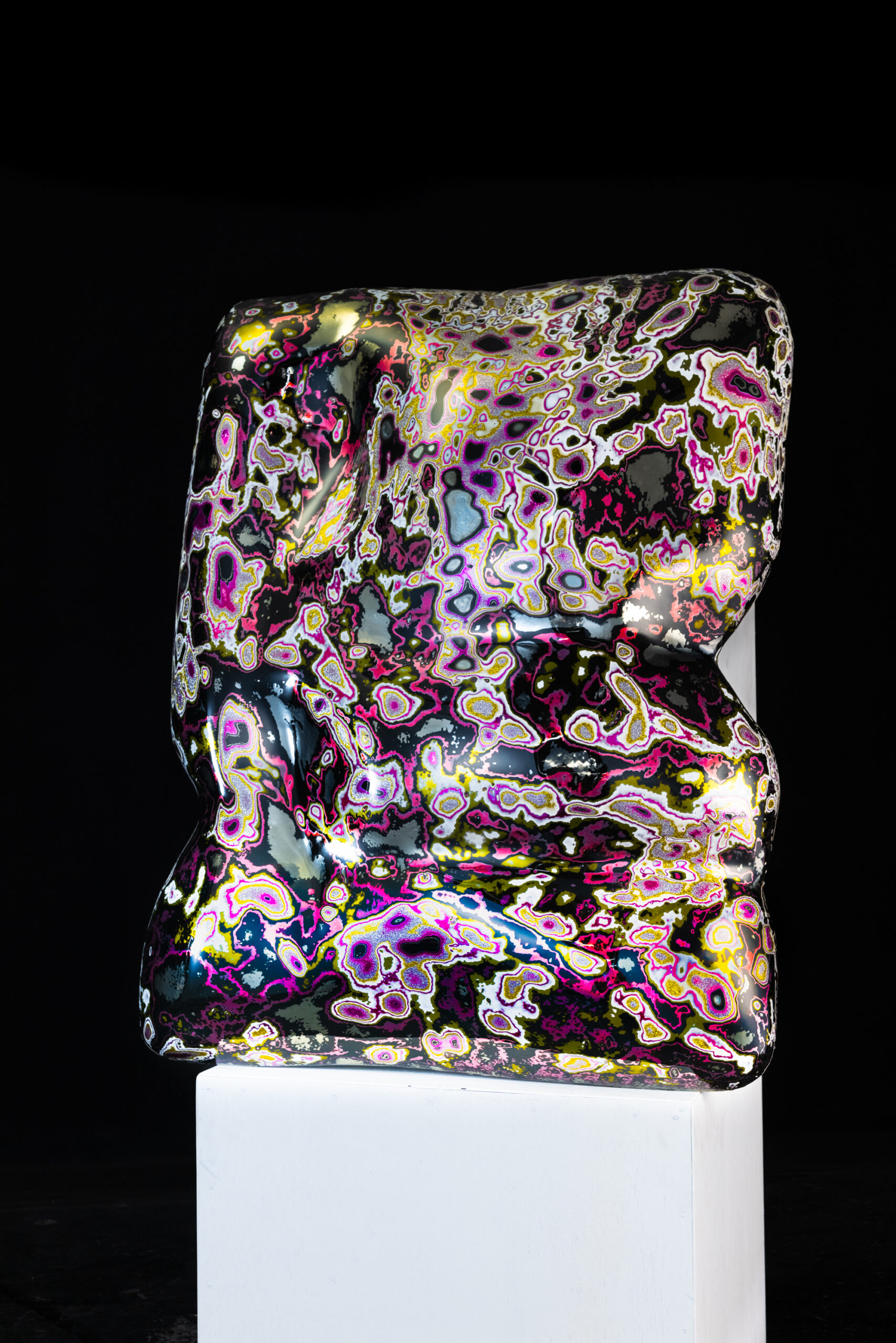
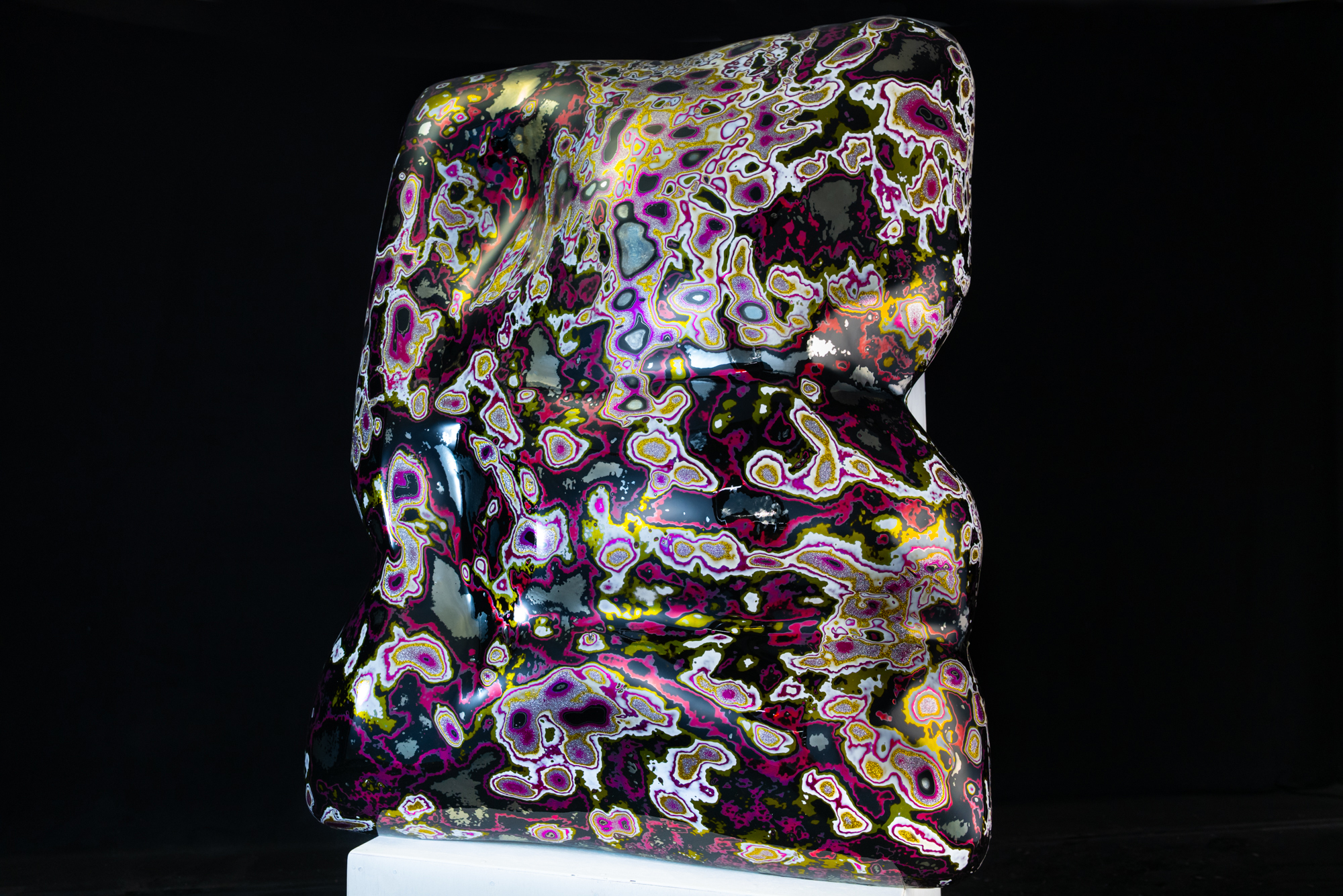
This work, *HAZE / The Abnormal Conceals Light*, quietly yet decisively challenges the framework of the “flat surface” that has long been taken for granted in painting. Unlike a standard rectangular canvas, the support—molded from fiberglass-reinforced plastic (FRP)—features an asymmetrical, organic outline. Its form is not merely a visual element; it functions as a vessel designed to capture and transform light.
A high-precision silver coating serves as the base layer on the surface, over which multiple layers of translucent color are applied. Thanks to this structure, light does not merely reflect off the surface but penetrates into the interior, emerging again after repeatedly reflecting and passing through the layers. As a result, the colors are not static but constantly shift in appearance depending on the viewer’s position and the lighting conditions.
These phenomena are not merely visual effects. They come into being only through the close interplay of multiple elements, such as the shape of the support, the precision of the coating, and the layering of the surfaces.The work as a whole emerges as a single structure in which light, material, and form are unified. Furthermore, this multilayered structure evokes a sense of the accumulation of time. The layers of paint, piled one upon another, encapsulate the creative process itself and quietly convey the depth of time that is invisible to the eye. At the same time, it resonates in some way with a Japanese sensibility—a sense of something transcending form and an awareness of the subtle presence dwelling within nature.
This work also serves as a gentle challenge to the notion that beauty lies solely in “perfect form.” Elements such as distortion and asymmetry are not flaws; rather, they act as catalysts for capturing light and creating a new kind of beauty. It is striking how the very fact of being unconventional is transformed into the work’s charm.
Spanning the realms of painting, sculpture, and industrial technology, this work offers an opportunity to reexamine the relationship between light and matter—or form. At the same time, it can be said to be a work that prompts a tangible shift in the very act of “seeing” itself.